Why Tarik Skubal is worth $450 million to the Mets
Over the last three seasons almost nobody has struck out more hitters and walked fewer, and he joins a Mets rotation that was middle of the pack and short on innings.
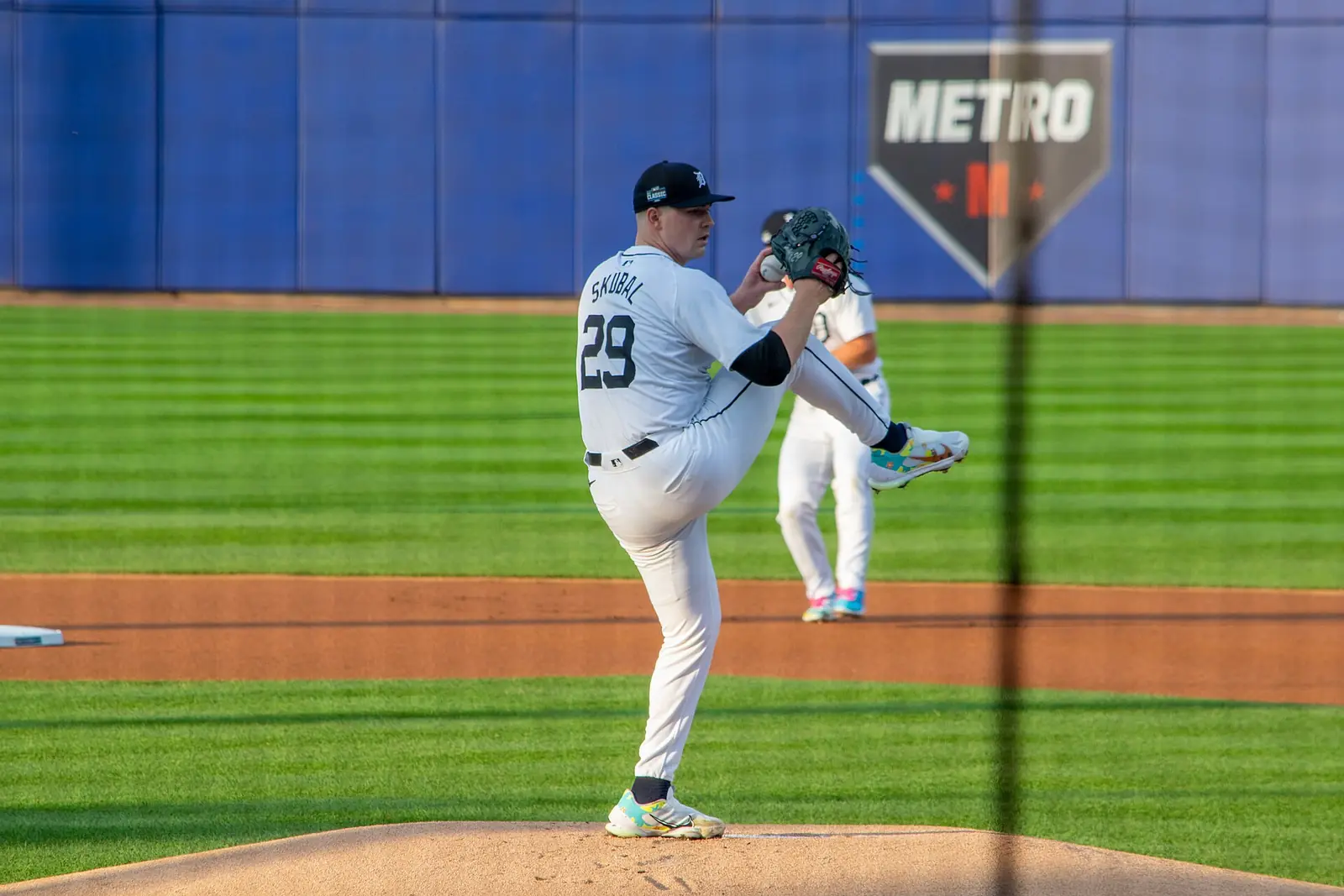

The Mets have agreed to a nine-year, $450 million contract with Tarik Skubal, the Associated Press reported Sunday, citing a person familiar with the talks. The deal is not official yet: it still needs a physical. If it goes through, it is the biggest contract ever given to a pitcher, about $50 million a year, with a $45 million signing bonus, $30 million deferred to 2036-45 and a full no-trade clause, per the AP.
That is a lot of money. Here is why, by the numbers, it is money well spent, and what could go wrong.
He is one of the two best pitchers in baseball at the thing that matters most
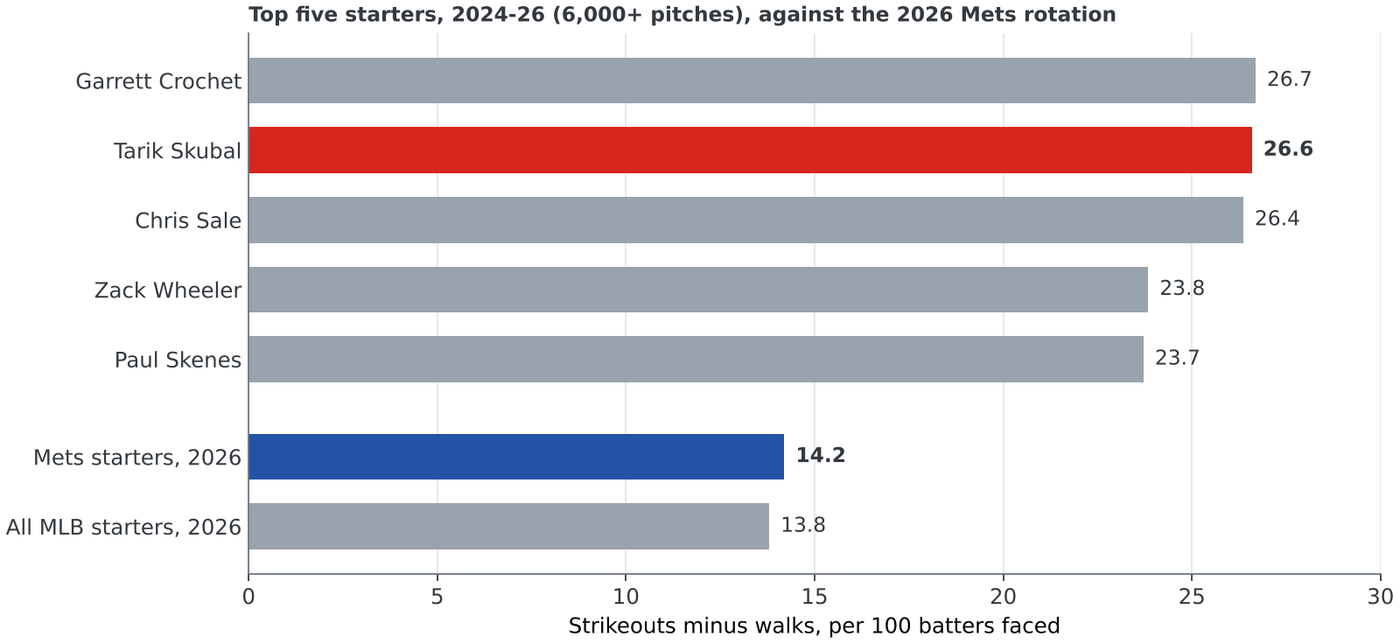
The simplest way to judge a pitcher is to count what he controls himself: strikeouts he gets and walks he gives up. Subtract walks from strikeouts and divide by batters faced, and you get a number that predicts future run prevention better than ERA does.
We ran that number for every pitcher who threw at least 6,000 pitches from 2024 through 2026, 73 in all, using pitch-by-pitch Statcast data for the regular season. Skubal finished second, a tenth of a point behind Garrett Crochet, and ahead of Chris Sale, Zack Wheeler and Paul Skenes.
Two other ways of measuring tell the same story:
- Runs saved, pitch by pitch. Statcast gives every pitch a run value: how much the ball, strike, out or hit changed the expected runs in the inning. Add up all of Skubal’s pitches from 2024 to 2026 and he took about 106 runs off the board compared with an average outcome. That is the most of the 73 pitchers. Yoshinobu Yamamoto was next at about 99.
- Quality of contact. Expected wOBA rates every batter’s result by how hard and at what angle the ball was hit, so luck and defense mostly drop out. Hitters managed a .261 against Skubal over those three seasons, second lowest of the 73 behind only Wheeler (.259). For reference, the league average was about .315 in those seasons.
He also almost never gives a free pass. He walked 4.4% of the batters he faced in each of the last two seasons, third lowest of the 73 over the three years.
The changeup is the weapon
Skubal throws a 97 mph fastball, and that gets attention, but the pitch that makes him different is his changeup, thrown at about 88 mph with the same arm action.
When hitters swung at it from 2024 to 2026, they missed 47% of the time. Among the 116 changeups thrown at least 600 times in that stretch, that was the second-highest miss rate in baseball. Its run value ranked third.
In 2026 he threw:
| Pitch | Share | Avg speed | Misses per swing |
|---|---|---|---|
| Four-seam fastball | 38% | 96.8 mph | 26% |
| Changeup | 26% | 87.7 mph | 47% |
| Sinker | 18% | 96.7 mph | 18% |
| Slider | 14% | 89.7 mph | 29% |
| Curveball | 5% | 80.4 mph | 40% |
Five real pitches, two of them hard and two of them breaking, means a hitter cannot sit on one thing. It also shows up in how often hitters chase: in 2026, 36.6% of his pitches outside the strike zone drew a swing, third most among 156 pitchers with at least 1,500 pitches. In 2025 he led that group.
What it fixes for the Mets
The Mets finished last in the NL East at 74-88 despite the highest opening-day payroll in the sport, and their starters had a 4.47 ERA, 23rd in the majors, per the AP.
Our data points to the same problem, and to two places Skubal helps right away:
- Missing bats. Mets starters struck out 14.2 more batters than they walked per 100 faced in 2026, 12th of 30 teams and barely above the league’s 13.8. Skubal’s 2026 number was 25.9.
- Going deep. Mets starters averaged about 4.8 innings a start in 2026, 22nd of 30, which left a lot of innings for the bullpen. Skubal averaged about 6.1 innings a start in each of the last three seasons, even in a year with elbow surgery.
One start every fifth day does not fix a rotation on its own. But pairing an ace who saves the bullpen a couple of innings a turn with younger arms like Nolan McLean and Christian Scott is how a team that won 74 games gets back to the playoffs.
Will Citi Field change anything?
Not much. From 2024 to 2026, 9.4% of fly balls and line drives at Citi Field left the park, against 8.6% at Comerica Park, Skubal’s old home, and 8.9% everywhere else. So Citi has been a touch more homer-friendly than Detroit in our data. That is a small difference, and Skubal gives up so little hard contact that it should not matter much. He also already pitched 10 starts in the National League in 2026 after the Tigers traded him to the Dodgers on Aug. 2, and went 5-2 with a 2.61 ERA there.
The risks
A nine-year deal for a pitcher is never safe, and this one has real questions:
- The elbow. Skubal had surgery in May 2026 to remove a loose body from his pitching elbow and missed about six weeks. He had Tommy John surgery in 2016 and flexor tendon surgery in 2022.
- A little less velocity. His four-seamer averaged 96.8 mph in 2026, down from 97.6 in 2025. It was not a steady slide after the surgery, though: by month it ran 97.2 in June, 96.4 in July, 97.1 in August and 96.8 in September. Worth watching, not yet a warning.
- Age. He turned 30 on Nov. 20. The deal runs through the season he turns 38.
- The calendar. Owners are expected to lock out the players in early December, which could cost part or all of the 2027 season. The AP reports the signing bonus is shielded from a lockout.
Even with those risks, there are not many pitchers worth building around for nine years, and over the last three seasons the numbers say Skubal is at or near the top of that short list. The Mets paid for the best, and the data says they got close to it.
How we measured: regular-season Statcast data, 2024 through Sept. 2026. Strikeouts minus walks, expected wOBA and run value are for pitchers with at least 6,000 pitches across the three seasons. Team figures count each game’s first pitcher as the starter. Contract terms, ERA, records and injury details are from the AP’s reporting and have not been confirmed by the Mets.