With runners on, fewer low pitches are called strikes
At the bottom edge of the zone, about 4 points fewer taken pitches are called strikes with men on. Whether the catcher's setup or the umpire's view loses them is open.
This is your last free article this month. They reset on December 1. Subscribe for unlimited
Five ways the game situation changes what players do, each checked against the data.
The short version
- The low strike with men on: about 4 fewer called strikes per 100 taken pitches at the bottom edge. Whether the catcher or the umpire loses them is open.
- A runner on third, under two out: hitters swing about 5 points more often at the same pitch. Which situation does the moving is open.
- Seeing a starter again soon: worth at most about 2 swings and misses a club-season, and maybe just who plays.
- The pitch in the dirt with a runner on third: on average, about as many as usual.
- A thin lead: no clear answer on whether relievers throw harder.
The low strike with men on
The belief: with runners on, the catcher sets up to block, and the low strike goes.
The low strike does fall. We took pitches the hitter let go within 3 inches of the bottom of a fixed strike zone, 2008-14 and 2018-26 (486,026 pitches). Raw, the low strike was called 39.1% of the time with the bases empty and 33.3% with men on.
Then we held the catcher, season, count, location (to 0.6 inch), pitch type and movement, pitcher, batter and game (so the same plate umpire). The gap was still 4.4 points (allowing for every test we could have run, 4.0 to 4.8), well past the 1.5 points we set in advance as worth caring about.
At the top and side edges, men on cost about a point (0.99). The top edge alone flipped direction between our first look and the test seasons, so we only report it. The bottom edge loses 3.4 points beyond the other edges (range 2.8 to 3.9), also past the bar. A check that should read zero, using runners who reach base later in the inning, reads +0.74 (range -0.35 to +1.84): quiet, as it should be.
What we can’t say: this is the call the battery and umpire produce together, not a measured catcher’s stance. Comparing with the other edges can’t tell the catcher’s blocking setup from an umpire’s poorer view of a low pitch over him. Pitch speed and where the catcher set his target aren’t held. So this is the pattern, not proof that catchers lose the strike.
In practice (simple arithmetic, not a finding): about 19 fewer called strikes a club-season, 15 of them beyond the other edges. At roughly 0.12 runs a call, that’s about two runs. Pitch-framing numbers that lump all base situations together mix spots 4 points apart at the knees.
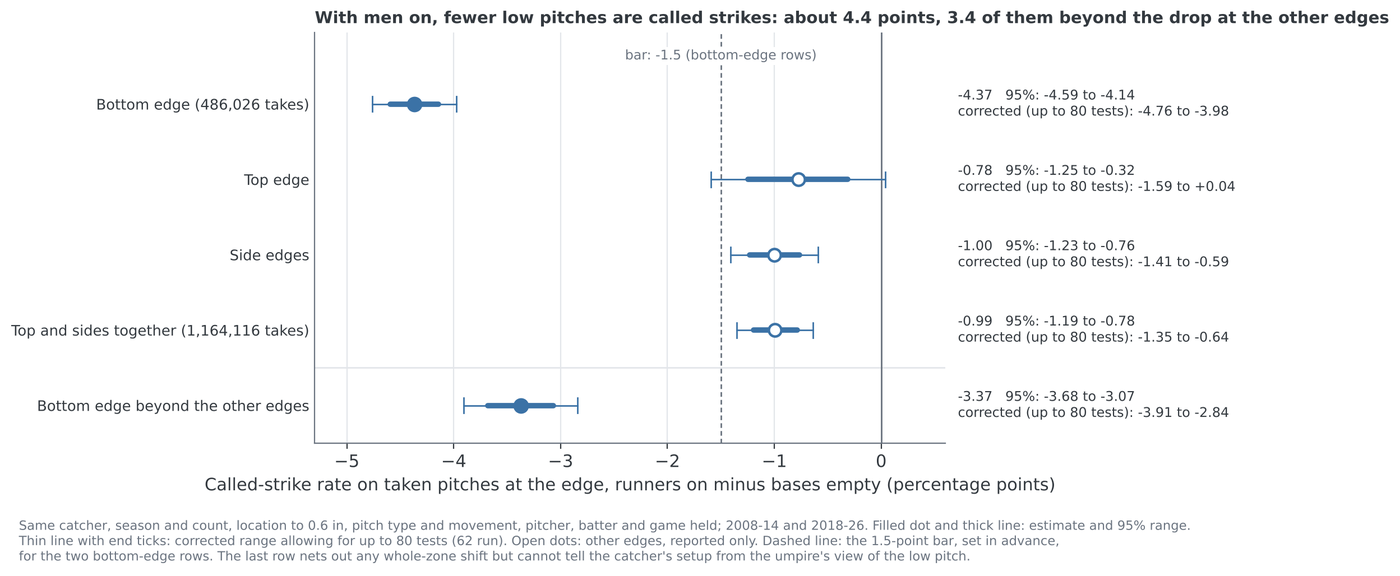
Points of called-strike rate, runners on minus bases empty. Thick line: the likely range; thin line: the wider range after allowing for up to 80 tests (62 were run). Open dots: the other edges, reported only. Dashed line: the 1.5-point bar, set in advance.
Playing the situation
The decision: does a hitter change his swing for the runner and the outs?
We compared pitches of the same type, location (to 0.2 ft), count and speed, within each hitter’s season, 2008-14 and 2018-26. With under two out, a hitter swings 5.2 points more often with a runner on third than with a runner on second and third base empty (range 4.9 to 5.4; the bar was 1 point). The same holds with the pitch number in the inning held.
On those pitches he also misses 1.3 points less per swing than in every other situation with under two out (range 1.0 to 1.6). But with the pitch number held the range is 0.9 to 1.5, so the size isn’t established against the 1-point bar. Without any adjustment he misses 0.5 more, not less: the gap mixes what he’s thrown with which pitches he chooses to swing at.
What we can’t say: the two situations differ; which one moved isn’t established. The comparison situation itself (runner on second) brings 1.7 to 4.0 points more swings than the bases empty, depending on the outs. The pitcher’s form that day isn’t held.
With two out and nobody on, the “swing for power” advice doesn’t show up: 1.2 more misses per 100 swings than leading off an inning (range 0.9 to 1.4; size not established), and contact about 0.3 mph softer (not cleanly established).
Seeing a starter again
The decision: does a lineup hit a starter better the second time in three weeks?
Barely. Over 7,303 repeat starts against the same club within 4 to 21 days (2008-14, 2018-26), the club’s swings and misses dropped 0.29 points per 100 swings (range -0.58 to +0.00). That rules out a club-wide gain of 0.6 points or more. The hitters who had seen him missed 0.46 less (range 0.15 to 0.78, below the 1-point bar).
What we can’t say: the same hitters already missed 0.25 less in the first meeting, before any look (a check run after the fact). So the gain isn’t separated from who plays both games, or from having seen his rotation-mates. In repeat starts the pitcher also throws fewer pitches in the zone (0.21 points fewer) and gets 0.42 points fewer called strikes per taken pitch: the battery adjusts too. Simple arithmetic, not a finding: about 0.12 to 0.15 swings and misses a repeat start, about 2 a club-season.
The pitch in the dirt
The decision: with a runner on third, does a pitcher stop burying two-strike pitches?
Not on average. About one in eight of 763,996 two-strike pitches lands below a foot off the ground. With a runner on third, compared with a runner on second, that share falls 0.16 points (range -0.44 to +0.12). On average, a drop of 0.44 points or more is ruled out (the bar was 1.5).
What we can’t say: the average hides two pieces pointing opposite ways. With two out, about one fewer such pitch per 100 (-1.02, range -1.43 to -0.60); under two out, about half a pitch more per 100 (+0.47). These are leads, not findings, and hidden choices by the battery could offset a drop. Simple arithmetic: about 1 pitch a club-season.
Thin leads
No clear answer yet. Relievers entering in the seventh or later with a lead of one to three runs throw fastballs 0.046 mph faster for each run less of lead (range 0.021 to 0.070). That’s against a bar of 0.1 mph per run (0.2 mph from up three to up one); the slope gives about 0.09. But a check that should have read zero didn’t, and a cleaner version reaches zero. A lift above about 0.07 mph per run is ruled out; a smaller one can’t be told apart from which relievers get used and drift over the game.
So what?
- With men on, the low strike is worth about 4 points less, whoever loses it.
- Expect more swings with a runner on third and under two out, without knowing which situation does it.
- A second look at a starter is worth at most about 2 swings and misses a club-season, much of it possibly who plays.
- The buried pitch barely changes on average, about 1 pitch a club-season.
- A thin lead’s extra speed is at most about 0.09 mph by the slope, and possibly just selection.